
About Alireza Hayati

Hacker, cypherpunk, and user freedom activist.

Why I don’t support cases against vaccines

I read a post on Bill Gates’ blog about polio. It talks about how vaccines helped us survive the disease and easily walk. Thousands of people were infected with polio during time and lost ability to walk or even stand. The suggested cure for polio was a metal tank, an iron lung, a mechanical respirator.

Polio attacks the body’s nervous system, crippling patients. In the worst cases, the disease paralyzes their respiratory muscles and makes it difficult for them to breathe, sometimes resulting in death.

Using changes in air pressure, the iron lung pulls air in and out of a patient’s lungs, allowing them to breathe and stay alive. During the height of the polio epidemic in the U.S. in the 1940s and 1950s, rows of iron lungs filled hospital wards to treat thousands of polio patients, most of them children.


Today, we don’t need iron lungs anymore as there’s an effective vaccine for it. Every person now gets vaccinated against polio and, since 1988, the world decided to eradicate the disease. Polio cases dropped since then by nearly 100 percent.

Before vaccines, more than 350 thousand people were infected in a year, facing horrible consequences and difficulties in their life but now there’s fewer than 200 cases yearly only in two countries, Afghanistan and Pakistan, in which extremists force people to avoid vaccines using religious propaganda.

Today, some people are spreading false information about vaccines claiming a vaccine is a conspiracy to turn people to something other than a human or vaccines are tools to impose surveillance on people. Of course some vaccines are not effective, we’ve seen them, but to induce that vaccines in general are harming people, that makes no sense.

I’ve seen the effect of vaccines on people. From influenza to polio to tetanus and Meningococcal vaccines, I’ve seen how they help people live and be healthy and I’ve seen how without them people are harmed and face difficulties, even death.

I’m not yet vaccinated against coronavirus (COVID-19) but I will be when it’s time for people my age. My grandparents and some relatives are vaccinated. They didn’t face any aftereffects. One of my relatives was vaccinated while his family were not, and I’ve seen how all of his family members got sick but he were OK. All of them recovered, happily.

Vaccines are results of scientific works, and I believe in science. People say science is always changing and is not reliable but that’s one reason I support it. Science always changes and gets updated for better. That’s why I rely on it. When it comes to vaccines, science is proven to be always working to get better, from iron lungs to polio vaccines, it’s always working to help people.


Part of this post is taken from gatesnotes.com. Check their terms of use/copyright notice.
Fedora (Red Hat) removed a contributor because of his nationality

Ahmad Haghighi, a Fedora GNU+Linux contributor and ambassador was removed from the project because of his nationality. He mentioned this in a tweet announcing his contributions and posts in “Ask Fedora” are removed. Even the long first post of the Persian Ask Fedora is removed.

Matthew Miller, Fedora Project Leader and engineer at Red Hat said that “haghighi linked to a bio page he created on Fedora wiki which states that his location is in Iran. Once Fedora as a project becomes aware of that information, we have no option. Personally, I do not think this is a good policy. But it is not a Fedora policy or Red Hat policy — we need to do it to comply with the law, which the US government enforces seriously.”

I stopped using Fedora because of the same thing. The fact that Fedora complies with U.S. laws no matter if it imposes injustice on people is very disappointing for me. I know they are forced to do this but that doesn’t mean I can ignore this injustice.

Free software philosophy won’t allow any restriction on using the computer program, but doesn’t say anything about who can contribute on the main project. I believe the base of that is to restrict developers from doing injustices to people and since I believe the philosophy of free software is to avoid injustices, I believe this kind of act is against the soul of software freedom.

This action, whether from U.S. government or anyone else, is very hurtful not only to free software community but to all people and should be stopped. Whether it’s law or not doesn’t justify the action. I understand they’re forced to but don’t ask me to understand I’m considered an illegal being because of my location or nationality.

Happy birthday Alan Turing

It’s June 23rd, Alan Turing‘s birthday. Turing is considered to be the father of theoretical computer science and artificial intelligence. He aged 41 years, but would be 109 years today.

Turing was prosecuted in 1952 for homosexual acts; the Labouchere Amendment of 1885 had mandated that “gross indecency” was a criminal offense in the UK. He accepted chemical castration treatment, with DES (a non-steroidal estrogen medication), as an alternative to prison.

Turing died in 1954, 16 days before his 42nd birthday, from cyanide poisoning. An inquest determined his death as a suicide, but it has been noted that the known evidence is also consistent with accidental poisoning.

Today, in a good news, the new £50 note featuring Alan Turing has been released into circulation by the Bank of England. A man who once was persecuted because of his sexual orientation is now pictured and celebrated on the highest bill in England.

Happy birthday Alan Turing, father of our computers.

Continue the action

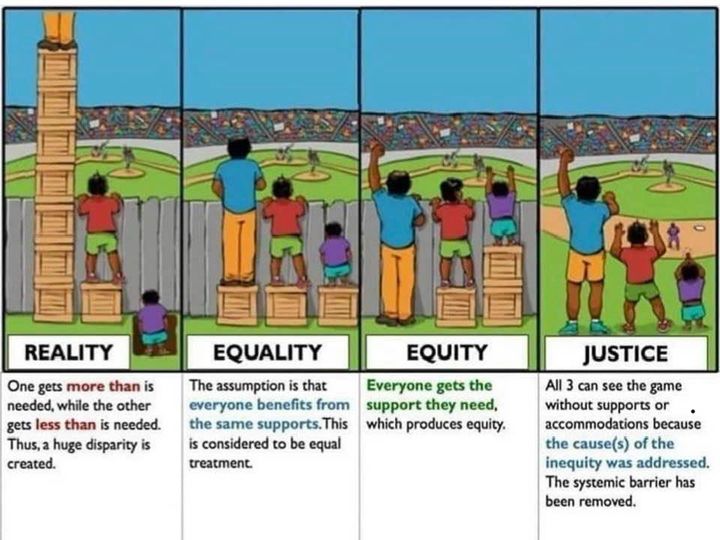
I’ve seen the above photo (post) and wondered is that really justice? I’ve posted a similar post before but in that post, the situation imposed on people was natural, not human-made. I understand the good intention creator of the photo has but it occurred to me that this is enough for many people.

Just like how most slavery abolitionists stopped after the slavery became illegal, many stop their action when some part of injustice is addressed. In the above photo, the situation is not natural, it’s human-made. The fence is built by humans and it is probably not only for animals, it’s also too keep some people out.

I believe the true justice (in the situation described in the photo) is that they get equal chance, equal opportunity, and equal respect to watch the game from stand among others and get enough/equal chance to contribute to the society they’re in, not to be kept out among animals.

Privacy vs. “I have nothing to hide”

To start this article, I should mention what those words mean. Freedom means “the power or right to act, speak, or think as one wants without hindrance or restraint” and liberty means “the state of being free within society from oppressive restrictions imposed by authority on one’s way of life, behavior, or political views.” However, from now on, when I use any of those words, I mean both of them. So whether I write freedom or liberty, I mean “freedom and liberty”.

I value my liberty. I think liberty is what makes humans, humans. As a Middle Eastern, I understand how much my freedom is valuable and important. Us Middle Easterners are very much familiar with struggles one can have to gain freedom.

We fight for freedom in Middle East. If you’ve followed Middle East news in past 10 years, you surely understand what I’m talking about. Part of our fight for liberty needs us to be anonymous. In Middle East, you may get arrested or executed for simply talking against the dictator, so many of people take anonymity very serious when they talk politics, or anything else.

Anonymity is part of privacy. Anonymity is a choice when someone has privacy. I should explain this too. Being anonymous is a choice while privacy is a right. Someone with privacy can or may be anonymous but one can be identified and known while one still has privacy. I for example am active in a social network with my real name but I still take my privacy seriously, and am careful about my computing and acts.

Now back to what I was saying. In a situation like Middle East, privacy is so essential for living that almost everybody takes it seriously. I don’t mean all people are avoiding Google or Facebook, etc. but I mean they try their best to not give their data to the government.

People in Middle East basically understand the value and importance of privacy. However, even in Middle East, many people give me the argument of “I have nothing to hide” and refuse to take their privacy and rights seriously. Many don’t understand with not taking their privacy seriously, what they’re giving away.

To live as a free human being, and not be controlled or conquered by any person or power, you need privacy.

Arguing that you don’t care about the right to privacy because you have nothing to hide is no different than saying you don’t care about free speech because you have nothing to say.

Edward Snowden

Let’s start arguing against the “I have nothing to hide.”

Continue reading

Israeli apartheid

Many people think of Israel and Palestine as two countries at war; with Israel, a state for Jewish people, occupying Palestine, where Palestinians live.

The truth is both Israeli Jews and Palestinians live all over the territory, ruled by one government and one army based on the idea of advancing the supremacy and domination of one group of people of Jews and that is what guides its policies and its practices towards Palestinians. In other words: Apartheid.

Continue reading

Ferdowsi’s commemoration day

Abul-Qâsem Ferdowsi Tusi (or just Ferdowsi) is probably the greatest Persian poet of all time. His book, Shahnameh (The Book of Kings), is known as the book that keeps the Persian language alive. Ferdowsi is celebrated as one of the most influential figures of Persian literature and one of the greatest in the history of literature.

The writing of Shahnameh took 33 years. The Shahnameh is a monument of poetry and historiography, being mainly the poetical recast of what Ferdowsi, his contemporaries, and his predecessors regarded as the account of Iran’s ancient history.

Ferdowsi is one of the undisputed giants of Persian literature. After Ferdowsi’s Shahnameh, a number of other works similar in nature surfaced over the centuries within the cultural sphere of the Persian language. Without exception, all such works were based in style and method on Ferdowsi’s Shahnameh, but none of them could quite achieve the same degree of fame and popularity as Ferdowsi’s masterpiece.

Ferdowsi has a unique place in Persian history because of the strides he made in reviving and regenerating the Persian language and cultural traditions. His works are cited as a crucial component in the persistence of the Persian language, as those works allowed much of the tongue to remain codified and intact.

In this respect, Ferdowsi surpasses Nizami, Khayyám, Asadi Tusi and other seminal Persian literary figures in his impact on Persian culture and language. Many modern Iranians see him as the father of the Persian language.

Ferdowsi was buried in his own garden, burial in the cemetery of Tus having been forbidden by a local cleric. A Ghaznavid governor of Khorasan constructed a mausoleum over the grave and it became a revered site. The tomb, which had fallen into decay, was rebuilt between 1928 and 1934 by the Society for the National Heritage of Iran on the orders of Reza Shah, and has now become the equivalent of a national shrine.

Every year on Ordibehesht 25 (Persian Jalali calendar), people gather in the tomb and celebrate his legacy by reading Shahnameh and washing his grave stone.

I’ve reached the end of this great history

And all the land will talk of me:

I shall not die, these seeds I’ve sown will save

My name and reputation from the grave,

And men of sense and wisdom will proclaim

When I have gone, my praises and my fame.

The modern slavery between monkeys!

There were a group of scientists who were doing some experiments on some monkeys. The put five monkeys in a cage and made them live there. In the cage, they put a ladder and above the ladder, they put some bananas.

Every time a monkey tried to climb the ladder and get some bananas, the scientists poured very cold water on other monkeys that were under the ladder, they shocked those who were under the ladder.

After a while, whenever a monkey tried to climb the ladder to get some bananas, other monkeys would pull the climbing monkey down and beat that poor one. A while passed and none of the monkeys, despite the inherent desire to the bananas, would climb the ladder because they were afraid of getting beaten by others.

The scientists decide to replace one of the monkeys, monkey number one, with another monkey that has no idea about the situation in the cage. When they replace monkey number one, the new monkey tries to climb the ladder and others pulled it down and beat it.

After a few times of getting beaten, the new monkey also decided to not climb the ladder for bananas, even though it has no idea why climbing the ladder is forbidden. When this happened, scientists replaced monkey number two with a new monkey.

Monkey number two was replaced and the same situation went on. New monkey tried to climb the ladder and got beaten and after a few times it decided to not climb the ladder even though it didn’t know why it is forbidden to climb the ladder or eat the bananas on top.

This went on until all the monkeys were replaced by new ones. Now none of the first monkeys are in the cage and all are replaced by new ones, and none of the new ones ever experienced the cold water but every time a monkey wants to climb the ladder, it gets beaten.

If we could continue the experiment and ask the monkeys why they beat the climbing monkey, their possible answers would be 1: I don’t know, it’s tradition, everybody does it; and 2: I don’t know, this is what is popular among other monkeys, you should obey the public.

Traditions and belief in the societies may have a very interesting or convincing root but they may be obsolete nowadays. I’m not trying to argue about the root of the problems, but how or whether they are affecting us today.

What I wrote was simply imposing a modern slavery of thought on monkeys. A similar story happened to humans, I believe. I truly believe we humans are experiencing a form of slavery, a modern new slavery, in which we have no idea why we do certain things or obey certain systems, but we’re too afraid of getting hurt to disobey it or act against the mainstream.

We are too afraid of swimming against the river, and even if we try to do, other fishes will stop us, and if you ask why they do it, they have no answer, they simply believe our actions are not right.

I try to change this, and I hope you join me.