
Google is no better than TikTok

There are new concerns about new famous video-sharing app TikTok and its privacy. TikTok, the video-sharing app whose meteoric rise amongst teenage users has made it a challenger to the likes of Facebook, is under attack thanks to its Chinese roots.

The Trump administration said this month it’s considering banning the app in the US altogether. Secretary of State Mike Pompeo first broke the news on Monday, telling Fox News’ Laura Ingraham the administration was considering a ban on national security grounds.

It’s actually funny that a lot of people are now considering deletion of the app for privacy reasons but they have no problem with Google, Facebook, Amazon, etc. for the same thing. It’s safe to say that TikTok has even less data of users than Big Tech.

Pompeo says that using TikTok could mean people’s data ends up “in the hands of the Chinese Communist Party.” It may be correct. I encourage you to uninstall this software too. Not only this app but every proprietary privacy-violating app you have.

But something I don’t understand is that how people can be concerned about a company because it has Chinese roots but be completely OK with another company that even collects and processes more data only because it’s American.

If TikTok collecting data is bad, Google harvesting data is worse. I believe United States officials are well aware of how Google and other American companies harvest people’s data. I’m also sure that U.S. Government has no problem with people’s privacy being violated.

New concerns and media attention to TikTok is just another political game between U.S. and China. Some political analysts believe putting a ban on TikTok is just to punish China for coronavirus.

Anyway, as I said, I totally encourage people to delete the app as much as I encourage people to move away from Google and any other privacy-violating proprietary software/company. It would be just ridicules if you are concerned about privacy of TikTok but not the same situation on Google, etc.
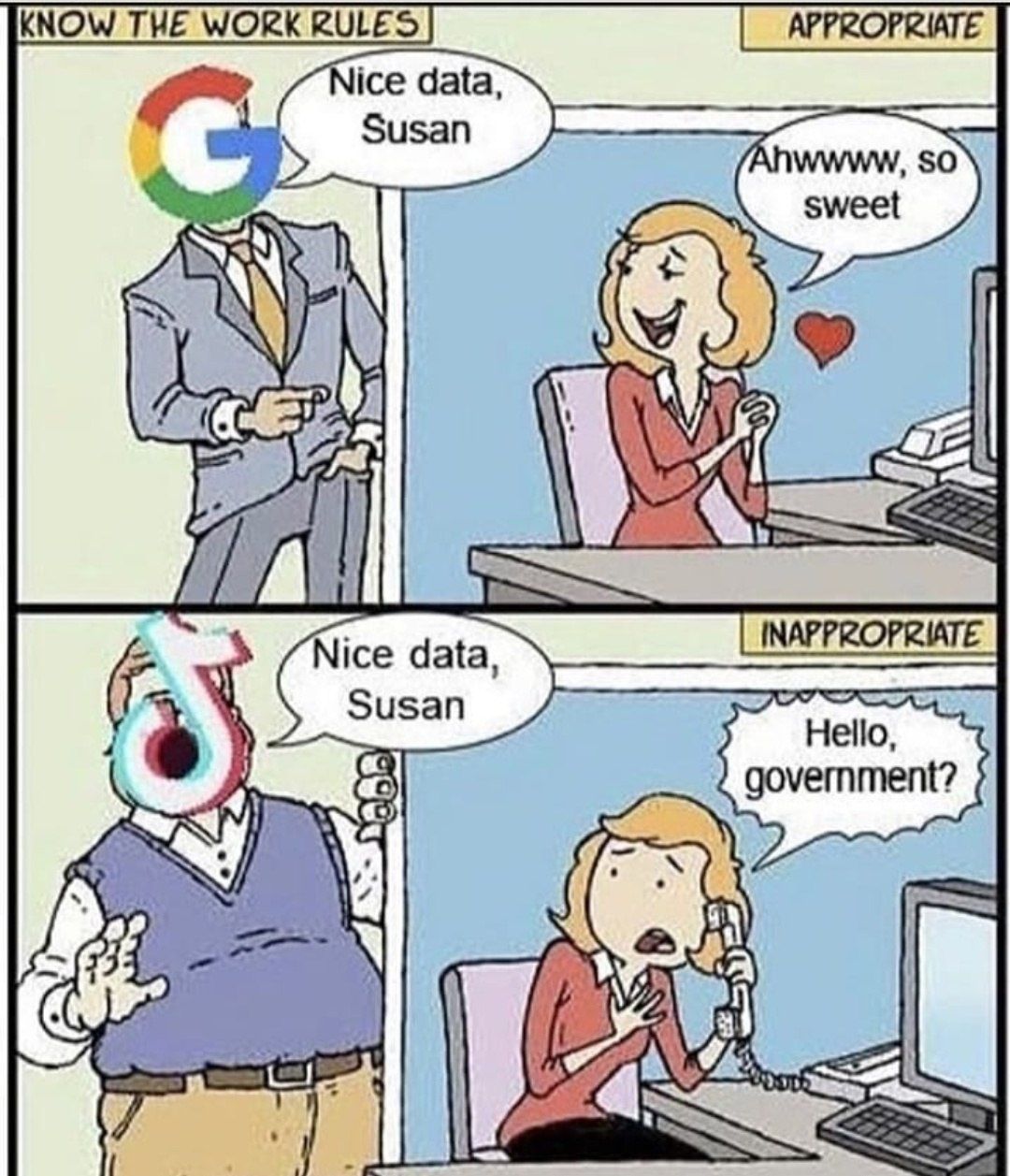
Dual standard for Google and TikTok

Don’t be a digital slave, fight for yourself

During the time that slavery was legal in United States, there were a lot of fugitive slaves who fought for their freedom. They either gained it or died proudly. A lot of slaves ran away from United States to where slavery was not legal.

During these times, there were also some slaves who believed that it’s white people’s right to enslave black people. They liked slavery and they liked to be enslaved. They fought against running slaves and they served their masters proudly.

During the Civil War in the United States, some of confederate soldiers were black people. You may start thinking that maybe slavery was not that bad, huh? WRONG. Those slaves who fought against slavery were not seeking power or anything. They fought for their freedom and humanity. Those slaves who fought against freedom fighters were not free or living a good life.

Most of them were slaves just like other slaves. The only difference was that so-called masters were shrewd enough to insinuate to them that it is the masters’ right to enslave them.

Today, we see slavery in digital worlds. I am very sorry that we have new digital slaves who are defending the rights of companies (new masters) against their (new slaves) own rights. Some people are defending Google and its allies even though they know that Google and its friends (Big Tech) is spying on them and violating their rights over freedom and privacy.

When you explain the situation to them, they simply respond that Google provides services, and when you tell them that are similar/same services that are libre and privacy-respecting, they simply respond with some idiotic response such as Google is better or Google is worldwide, etc.

They are slaves I talked about. Slaves who voluntarily are serving masters. Slaves who fight against their own freedom and rights. I still am unable to properly respond to them as I believe dealing with them needs special abilities that I don’t have, sadly.

Use free software for online studies and classes

Trump has a new plan to make foreign students’ lives difficult: bar them from the US if their schools are classes online.

Distance learning, as such, is not wrong. (Whether it is as good for learning as being in a university and going to classes physically is an open question, outside my expertise.) However, they are almost surely doing it with nonfree software, and that is an injustice.

I expect Trump is doing this simply as another way to express hostility to foreigners, and is not interested in what the universities do. But if this does help convince some universities to stop making students use nonfree software, that will be a positive side effect.

Use password managers for more safety

Passwords/passphrases are almost most important part of our digital (and even non-digital) safety and security. A password is the first layer of our security. For long time, passwords were our only shield against infiltrators.

With progress of technology and computer science, we found more effective ways to infiltrate people’s accounts. Crackers are now more likely to sabotage our accounts and data. Although this sabotage is not always bad, one cannot ignore the unpleasant aspect of the story.

An strong password or passphrase can make you more secure. But, the problem is most of the times we can’t remember what password we set for our account.

We may be able to remember a 20-letter long ‘passphrase’ but it’s obviously hard for us to remember a 35-letter password which contains uppercase/lowercase letters, numbers, and special characters. This is why we need password managers.

Continue reading

How would you write the rules?

Yesterday, Chris “Muesli” asked an interesting question that I thought can be a good blog post. If we were in power, what rules would be write?

You are to be born in 24 hours. You are also to write all the rules that will govern the society in which you will live. However, you do not know if you will be born bright or retarded, black or white, male or female, rich or poor, able or disabled.

How would you write the rules?

muesli
Continue reading

The origins of surveillance

According to Wikipedia:

Surveillance is the monitoring of behaviour, activities, or information for the purpose of influencing, managing or directing.

It is by no means a new concept, as the ability to know what your population is doing at any given time is extremely useful when trying to enforce laws. This is why even in the Bible, there are examples of what is thought to be surveillance:

One evening David got up from his bed and walked around on the roof of the palace. From the roof he saw a woman bathing. The woman was very beautiful, and David sent someone to find out about her. The man said, “She is Bathsheba, the daughter of Eliam and the wife of Uriah the Hittite.”

2 Samuel 11-12

Later in the passage, David goes on to sleep with Bathseba, even though she was already the wife of Uriah. Cleary, in this example, surveillance was used for David’s own personal gain and pleasure rather than for the greater good.

There is even evidence to believe that the ancient Egyptians were using forms of surveillance, according to Terry Crowdy in his book The Enemy Within: A History of Espionage.

The Hittite king Muwatallis sent two spies into the Egyptian camp posing as deserters to convince pharaoh that the Hittite army was still quite distant. Rameses believed their story and unwittingly allowed part of his army to march into a Hittite ambush.

However this is not the same form of surveillance that we are used to today. David was not using CCTV to spy upon Bathseba, nor was Muwatallis when he sent spies to the Rameses.

If we want to figure out how long mass surveillance (as we understand it today) has been going on, we only need to look back to the 2000’s, and we know that the first CCTV was only used in 1927. We can even study the use of surveillance in Nazi and Communist regimes, but if surveillance is such a new concept then how do we explain the use of spies in Egypt or David in the Bible.

This then begs the question as how we define surveillance? If we use the definition at the beginning of this article then both of these cases count. However if both of these cases count, then why are some of us fine with our country spying, and yet not with the use of security cameras?

I think it comes down to a very human instinct. We don’t really notice if something bad is happening to someone else if it doesn’t affect us, it is only when it does that we take a stand.

I think the poem by Martin Niemöller sums it up well:

First they came for the socialists, and I did not speak out—because I was not a socialist.Then they came for the trade unionists, and I did not speak out— because I was not a trade unionist.

Then they came for the Jews, and I did not speak out—because I was not a Jew.

Then they came for me — and there was no one left to speak for me.

So where did surveillance originate? It’s hard to tell. The issue has now become much more prominent thanks to works such as Orwell’s 1984 or Ed Snowden’s revealing of the NSA’s spying capabilities and the constant articles about Facebook and Google’s abusive privacy policies.

I think it is fair to say that the act of watching and monitoring others has been going on for longer than we can prove, it’s only recently that we’ve started to record it.

The importance of license in libre works

One of the most important parts of free software movement is license. Choosing a license is one of the constant concerns of the free software and free culture community. As you know, a work is considered libre only if it’s published under a free (as in freedom) license.

One of the problems is that it happens a lot that a developer forgets to distribute his work under a proper license. Well it can be solved easily by reminding the community the importance of providing a license but the bigger problem is the license itself.

Most of the times, developer distribute their works with weak licenses or licenses that are not fully compatible with free (as in freedom) culture.

As far as I know, the most popular software license is Expat (MIT), as of 2020. MIT is a great simple libre license. However, it’s weak and not copyleft. I personally license my works under the latest version of GNU General Public License (GPL) but some people may don’t like it as they may find it unpleasing.

Anyway, what I’m talking about is the importance of license as the license specifies the terms of the software. Whether it can be used for progress of technology or helping the people or be used to please corporations, it’s all can be defined by the license.

Continue reading

Encryption is worthless unless we control the keys

A lot of companies advertise their encryption of data. Encryption is a good practice for privacy and security but it’s worthless sometimes. For example, WhatsApp encrypts messages but it’s worthless as it’s Facebook (WhatsApp’s owner) who creates and manages the keys.

What a secure messenger or any service should do is to let the user create and handle encryption keys. Let me give you another example. Imagine you want to send a letter to a friend and I’m the mail person. You give me your letter and I promise you to hide it. Now, I may hide it from other people but I still have access to it.

Encryption is like that. If you want to hide your letter, you should do it yourself and not trust anyone. As long as other services do the encryption for you or manage your keys, you’re not truly secure and that encryption is worthless.