
Data Privacy Day

Every year on January 28, we celebrate the international event of Data Privacy Day. The purpose of Data Privacy Day is to raise awareness and promote privacy and data protection best practices.

Privacy is a human right. Many people confuse privacy with secrecy and anonymity. While privacy is a human right, anonymity is a choice. Anonymity is one of choices made possible with privacy.

I’m very careful about my privacy and I take it very seriously while I’m not an anonymous person. I don’t have anything to hide, except for my personal data, but I’m still very cautious about privacy. Privacy is like free speech. I respect my right even if I have nothing to say, or hide.

As Data Privacy Day is about raising awareness about best practices of it, I decided to write a note about one of the ways I keep my personal files secure through encryption.

Continue reading
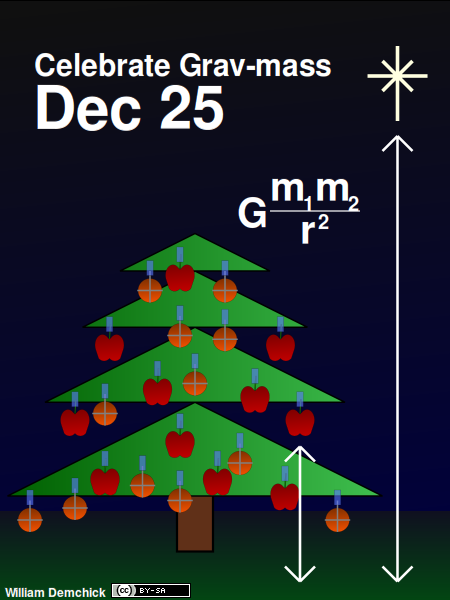
Celebrate Newtonmas (Grav-mass) with us

December 25 is the birthday of Isaac Newton. On this day, we celebrate the existence of comprehensible physical laws and we call it Newtonmas or Grav-mass. (2025-12-25 Update: I was today years old when I found out that Newton’s birthday is on December 25 Julius calendar; on current Gregorian calendar his birthday is on January 4th.)

The name Newtonmas can be attributed to The Skeptics Society, which needed an alternative name for its Christmas party.

Celebrants send cards with “Reason’s Greetings!” printed inside, and exchange boxes of apples and science-related items as gifts. The celebration may have had its origin in a meeting of the Newton Association at Christmas 1890 to talk, distribute gifts, and share laughter and good cheer.

One other way to celebrate Grav-mass is to decorate a tree with apples and other fruits. Glue them or attach them, but not too well! The idea is that occasionally a fruit should fall.

Another way to celebrate Grav-mass, in a group, is by telling each other about scientific knowledge and understanding, or discussing what kind of experiment could answer an unresolved question about the world.

Science-themed Grav-mass (Newtonmass) celebration poster with dark blue night background. White text at top reads ‘Celebrate Grav-mass Dec 25.’ A stylized green Christmas tree is decorated with red apples and orange ornaments representing masses. To the right, Newton’s law of universal gravitation is shown as ‘G m₁ m₂ / r²’ with vertical arrows indicating distance r. A star-like symbol appears near the top right. The tree stands on green ground with a brown trunk, blending physics concepts with a holiday Christmas tree illustration.

Newtonmass can be celebrated by anybody who loves science and wants to have a reason for a celebration. It’s not exclusive to any specific group or belief.

International Internet Day

​International Internet Day is celebrated globally on October 29 every year. International Internet Day is celebrated to commemorate a momentous day in the history of telecommunications and technology. The day marks the sending of the first electronic message which was transferred from one computer to another in 1969.

Charley Kline, a student programmer at the University of California, Los Angeles (UCLA), transmitted the first-ever electronic message on 1969 October 29.

Kline, who was working under the supervision of Professor Leonard Kleinrock, transmitted a message from the computer housed at the UCLA to Bill Duvall who was using a computer positioned at the Stanford Research Institute’s computer.

The sender system at UCLA was the SDS Sigma 7 Host computer and the receiver was the SDS 940 Host at the Stanford Research Institute.

The message sent was the word “login”. Kline and Kleinrock managed to send “L” and “O” before the connection between the terminals crashed.

To celebrate, here’s the video of David Bowie talking about internet (courtesy of BBC):

David Bowie predicted in 1999 the impact of the Internet in BBC interview (video is courtesy of BBC)

International Day for the Eradication of Poverty

The International Day for the Eradication of Poverty is an international observance celebrated each year on October 17 throughout the world.

The first commemoration of the event took place in Paris, France in 1987 when 100 thousand people gathered on the Human Rights and Liberties Plaza at the Trocadéro to honor victims of poverty, hunger, violence, and fear at the unveiling of a commemorative stone by Joseph Wresinski, founder of the International Movement ATD Fourth World.

In 1992, four years after Wresinski’s death, the United Nations officially designated October 17 as the International Day for the Eradication of Poverty.

Early in his career as an activist, Wresinski recognized that governments often ignored the plight of those living in poverty, leading to feelings of rejection, shame, and humiliation.

As a result, one of the primary goals of the Day is to recognize the struggles of the impoverished and to make their voices heard by governments and citizens. Participation by the poorest of people is an important aspect of the observance of the Day.

Wherever men and women are condemned to live in extreme poverty, human rights are violated. To come together to ensure that these rights be respected is our solemn duty.

Joseph Wresinski

Hafez’s commemoration day

In Iranian Jalali calendar, today, Mehr 20, is Khwāja Shams-ud-Dīn Muḥammad Ḥāfeẓ-e Shīrāzī’s commemoration day. He is also known and famous as Hafez.

He is one of mythical poets of Iran not only known inside the country but well known in many countries.

His collected works are regarded by many Iranians as a pinnacle of Persian literature and are often found in the homes of people in the Persian-speaking world, who learn his poems by heart and still use them as proverbs and sayings. His life and poems have become the subjects of much analysis, commentary and interpretation, influencing post-14th century Persian writing more than any other author.

Hafez is best known for his poems that can be described as “antinomian” and with the medieval use of the term “theosophical”; the term “theosophy” in the 13th and 14th centuries was used to indicate mystical work by “authors only inspired by the holy books” (as distinguished from theology).

Hafez primarily wrote in the literary genre of lyric poetry or ghazals, that is the ideal style for expressing the ecstasy of divine inspiration in the mystical form of love poems. He was a Sufi.

See how the roses burn!

Bring the wine to quench the fire!

Alas the flames come up with us,

We perish with desire.

Hafez

Happy Blog Day!

Blog Day (sometimes stylized as 3l0g Day) is an unofficial holiday celebrated by bloggers across the world on August 31. It was first marked in 2005.

The date of August 31 was chosen because 3108 (31st day of the 8th month) can be read as “blog”. The concept of the holiday is quite simple. On this day, bloggers are encouraged to recommend five blogs they consider interesting. A recommendation should contain a short description and a link to the recommended blog.

It is suggested that bloggers recommend blogs that are different from their own attitude, point of view and/or culture, because Blog Day is all about diversity! It is also important to notify the bloggers you’ve recommended and congratulate them on the holiday.

Sadly, Blog Day has not gained considerable popularity in the blogosphere.

If you don’t write a blog, start right now and join us. A blog doesn’t need to be technical or about a specific category/subject. You can use you blog to express your opinions or just to communicate with people, they way social networks can’t do. For many years, I’ve been writing different blogs and I have had an amazing experience, you should do it too.

Alan Turing birthday

June 23 is Alan Turing’s birthday. He was a mathematician, computer scientist, logician, cryptanalyst, philosopher, and theoretical biologist.

Turing was highly influential in the development of theoretical computer science, providing a formalization of the concepts of algorithm and computation with the Turing machine, which can be considered a model of a general-purpose computer.

Turing is widely considered to be the father of theoretical computer science and artificial intelligence. Despite these accomplishments, his accomplishments and true potential was never fully recognized in his home country during his lifetime due to his sexual orientation. Also because much of his work was hidden from public by the Official Secrets Act.

During the Second World War, Turing worked for the Government Code and Cypher School (GC & CS) at Bletchley Park, Britain’s code breaking center that produced Ultra intelligence. For a time he led Hut 8, the section that was responsible for German naval cryptanalysis.

He devised a number of techniques for speeding the breaking of German ciphers, including improvements to the pre-war Polish bombe method, an electromechanical machine that could find settings for the Enigma machine.

A true legend and a wonderful person. May you rest in peace, father of our computers.

World Refugee Day

On 2000 December 04, the United Nations General Assembly in Resolution 55/76 decided that, from the year 2000, day of June 20 would be celebrated as World Refugee Day. In this resolution, the General Assembly noted that 2001 marked the 50th anniversary of the 1951 Convention relating to the Status of Refugees. It is commemorated to honor all refugees, raise awareness and solicit support.

African Refugee Day had been formally celebrated in several countries prior to 2000. The UN noted that the Organization of African Unity (OAU) had agreed to have International Refugee Day coincide with Africa Refugee Day on June 20.

Each year on June 20 the United Nations, United Nations Refugee Agency (UNHCR) and countless civic groups around the world host World Refugee Day events in order to draw the public’s attention to the millions of refugees and Internally displaced persons worldwide who have been forced to flee their homes due to war, conflict and persecution.

The annual commemoration is marked by a variety of events in more than 100 countries, involving government officials, humanitarian aid workers, celebrities, civilians and the forcibly displaced themselves.

Many countries, specially European countries and Australia, are facing refugees crisis. Instead of helping people, they have decided to get involved in dehumanizing them. They closes their borders and there’s a lot of reports that these countries have left many refugees in distant areas from the countries or keep them homeless to die.

Just in April 2000, five boats carrying approximately 2000 migrants to Europe sank in the Mediterranean Sea, with the combined death toll estimated at more than 1,200 people.

International Day of Innocent Children Victims of Aggression

The International Day of Innocent Children Victims of Aggression is a United Nations observance each 4 June. It was established on 19 August 1982.

Originally focused on victims of the 1982 Lebanon War, its purpose expanded to “acknowledge the pain suffered by children throughout the world who are the victims of physical, mental and emotional abuse. This day affirms the UN’s commitment to protect the rights of children.”

The General Assembly, having considered the question of Palestine at its resumed seventh emergency special session, “appalled at the great number of innocent Palestinian and Lebanese children victims of Israel’s acts of aggression” decided to commemorate 4 June of each year as the International Day of Innocent Children Victims of Aggression. 31st plenary meeting 19 August 1982.

If you see child abuse or aggression against any child, please call your local child support center, police station, or social worker. Also, there’s a helpful article on Medical News Today.

Menstrual Hygiene Day

Menstrual Hygiene Day is an annual awareness day on May 28 to highlight the importance of good menstrual hygiene management. It was initiated by the German-based NGO WASH United in 2014 and aims to benefit women and girls worldwide. The 28th was selected to acknowledge that 28 days is the average length of the menstrual cycle.

In low-income countries, girls’ and women’s choices of menstrual hygiene materials are often limited by the costs, availability and social norms.Adequate sanitation facilities and access to feminine hygiene products are one part of the solution. Creating a culture that welcomes discussion and makes adequate education for women and girls is of equal importance. Research has found that not having access to menstrual hygiene management products can keep girls home from school during their period each month.

Menstrual Hygiene Day creates an occasion for publicizing information in the media, including social media. Public information campaigns can help to engage decision-makers in policy dialogue. The day offers an opportunity to actively advocate for the integration of menstrual hygiene management (MHM) into global, national and local policies and programs.